
Welcome to the online handbook for school boards of Catholic Schools. The New Zealand Catholic Education Office (NZCEO) has developed this resource to help school boards focus on the key aspects of a state-integrated school that differ from a state school.
The purpose of the handbook
This handbook is designed for all those involved in the governance of Catholic state-integrated schools, including board members, Proprietors’ appointees, principals, and senior leadership teams. Every member around the board table shares collective responsibility for the governance of the school, including upholding its Catholic special character. This shared duty is grounded in the contractual obligations outlined in each school’s Integration Agreement.
The online handbook site is the location of the most update information, guidance and resources for school boards.
The online handbook is not a legal document and should not be read as such.
A glossary of terms used in the Handbook is available.
More information and support:
 Visit the NZCEO website for further information and resources.
There are excellent governance guides available from the New Zealand School Boards Association and Ministry of Education that cover aspects common to both state and state-integrated schools.
The Catholic school
The Catholic school is a Catholic faith community within the wider faith community of the Catholic Church, including parish, diocese, and universal Church. Therefore, the Catholic school is an authentic expression of the Church’s mission to share the Gospel of Jesus Christ and to create a world of tika justice, pono truth and aroha love. The Catholic school is therefore a major place of evangelisation.
Catholic schools were established in Aotearoa New Zealand by parishes, diocese and religious institutions under the authority of the bishop of each diocese to provide a Catholic education for Catholic children.
Catholic schools were established to promote strong special character formation of young people based on Gospel values and Christian virtues by providing a quality education within the context of the Catholic faith. In doing so, Catholic schools support young people’s spiritual journey, hīkoi wairua and the passing on of faith to the next generation*.
The Aotearoa New Zealand Catholic education community diagram below sets out the relationships between the various Aotearoa New Zealand Catholic education entities within the Catholic education community.
*Excerts taken from Being Church in Aotearoa New Zealand Catholic Schools (2025)
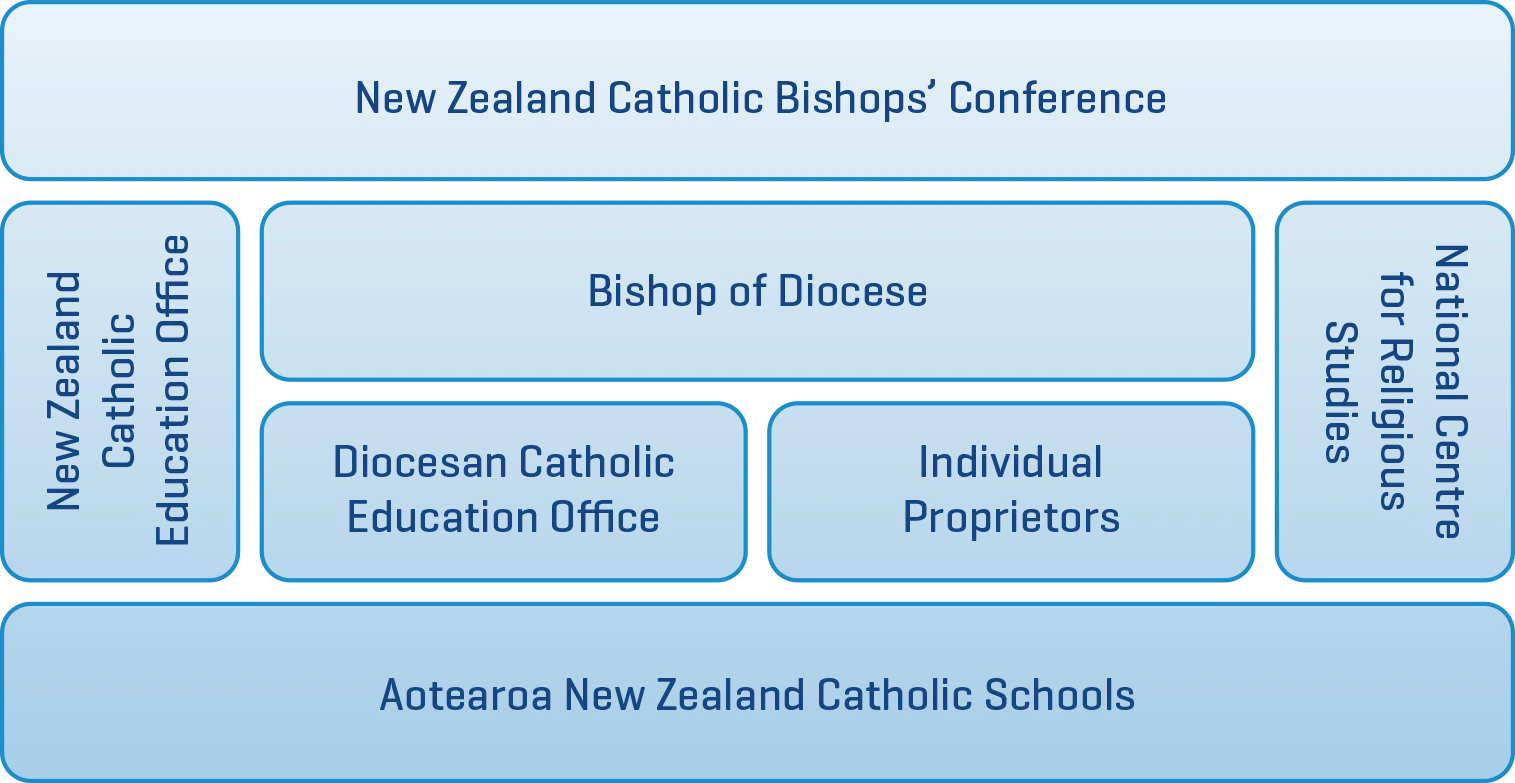
Refer to the glossary for roles and responsibilities of these entities.
Role of the school board in carrying out the mission of the Catholic Church
The school board exercises leadership, governance and sound decision making to safeguard and maintain the Catholic special character of the school. The board sets the strategic direction that places the special character formation at the centre of school life and makes policy and resourcing decisions that are sustainable and aligned with the school’s strategic plan. Through informed, prayerful and evidence-based decision making the board holds the principal to account for educational and faith outcomes, supports staff to integrate faith, culture and learning, and ensures that every significant decision is consistent with the values and teachings of the Catholic Church.
Te Tiriti o Waitangi
NZCEO’s position on Te Tiriti o Waitangi is grounded in Catholic social teaching, which acknowledges the special role of indigenous peoples and their rights to maintain their culture and heritage. NZCEO emphasises our commitment to Te Tiriti o Waitangi through our practice by reflecting its principles in our policies, work practices, documents, actions, decision making and advice.
“Te Tiriti acknowledges the special place of the Māori people as tangata whenua (the people of the land) – that is indigenous. They understand it to be a covenant and a taonga tapu (a sacred treasure). The Treaty provides the moral basis for the presence of all other peoples in Aotearoa (New Zealand) and guarantees reciprocal rights and obligations between the Crown and Māori.”
— NZ Catholic Bishops, 1990